
A directory of practical AI tools across the product lifecycle
Early in 2025, Hyperact released our Blueprint for modern product development. It was well received by a broad range of teams, from those already working in line with its principles to those aspiring to move in that direction.
One part of the blueprint maps different activities across each stage of the product development lifecycle. As we know, modern product development is rarely linear, and it almost never unfolds in the same way for every product, service or platform. Therefore, this section was intended as a guide: a set of activity categories that are likely to be useful at different points in your own journey.
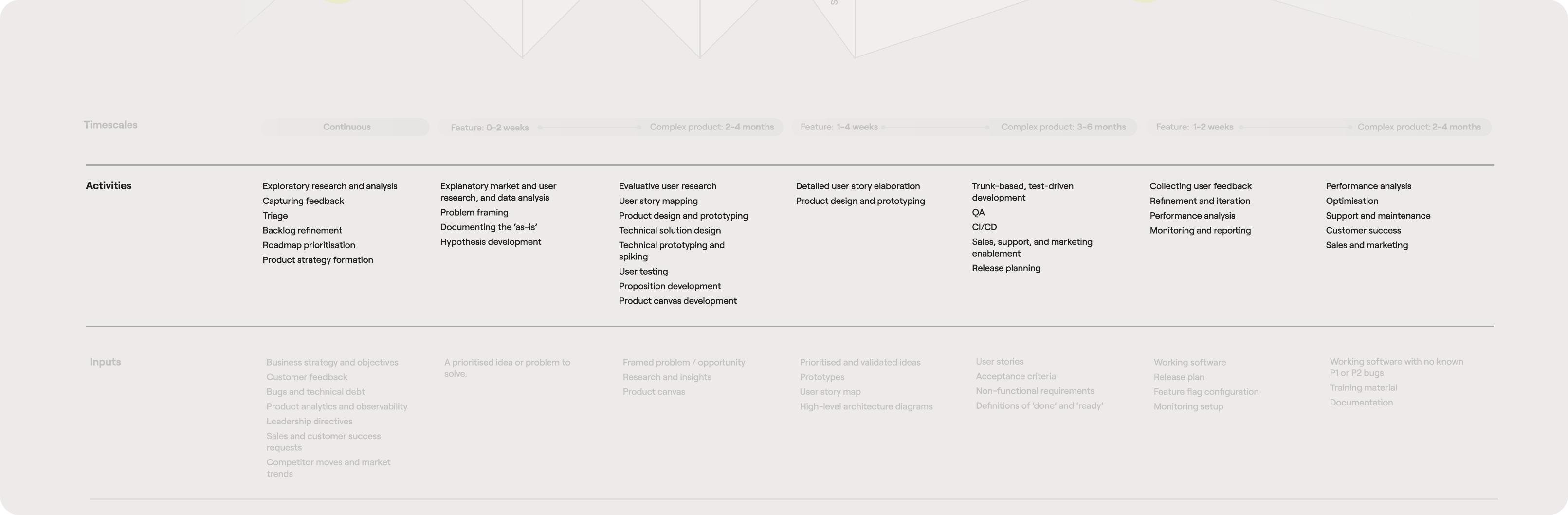
Most, if not all of these activities require the people who own, facilitate or participate in them to use tools, workflows and utilities in order to generate the outputs embedded in modern product development. Within this section sits a clear opportunity to accelerate and refine parts of the process, freeing up time and attention for the areas where teams create the most value.
It’s in this context that AI, often acting as a workflow assistant, has shifted from novelty to necessity. What began as experimentation is now embedded in everyday practice, spanning across all four steps: capture, discover, deliver and rollout. For many teams, AI is no longer a competitive advantage but a baseline expectation, reshaping how decisions are made, how quickly teams move, and what “good” looks like in day-to-day product work.
Why bother with AI tooling in your workflow?
1. They reduce cognitive load and context switching
AI-assisted tools reduce cognitive load by taking on mentally expensive, low-value tasks, helping teams maintain focus and minimise constant context switching across complex workflows.
2. They accelerate feedback loops without sacrificing quality
They accelerate feedback loops by compressing the time between action and insight, enabling teams to test assumptions, spot issues earlier and learn faster without lowering the bar for quality.
3. They improve consistency and reduce avoidable variation
They improve consistency by standardising common outputs and approaches, reducing avoidable variation while still leaving room for nuance where it matters most.
4. They create space for higher-value work
By automating repeatable tasks, AI tools create space for higher-value activities such as deeper problem exploration, stronger alignment and more deliberate decision-making.
5. They support better decision-making under uncertainty
They support better decisions under uncertainty by helping teams aggregate evidence, surface trade-offs and challenge assumptions more clearly.
6. They scale good practice, not just output
AI-assisted utilities scale good practice rather than just output, enabling teams to grow capability and quality without relying solely on increased headcount.
The directory
With this in mind, we’ve collated a directory of tools to use alongside the blueprint for you to browse and spot opportunities for you and your teams to explore new ways to use AI.
*Please note: Hyperact is not affiliated with any tool or business we have recommended in the directory.
The image shows how the sheet has been organised.
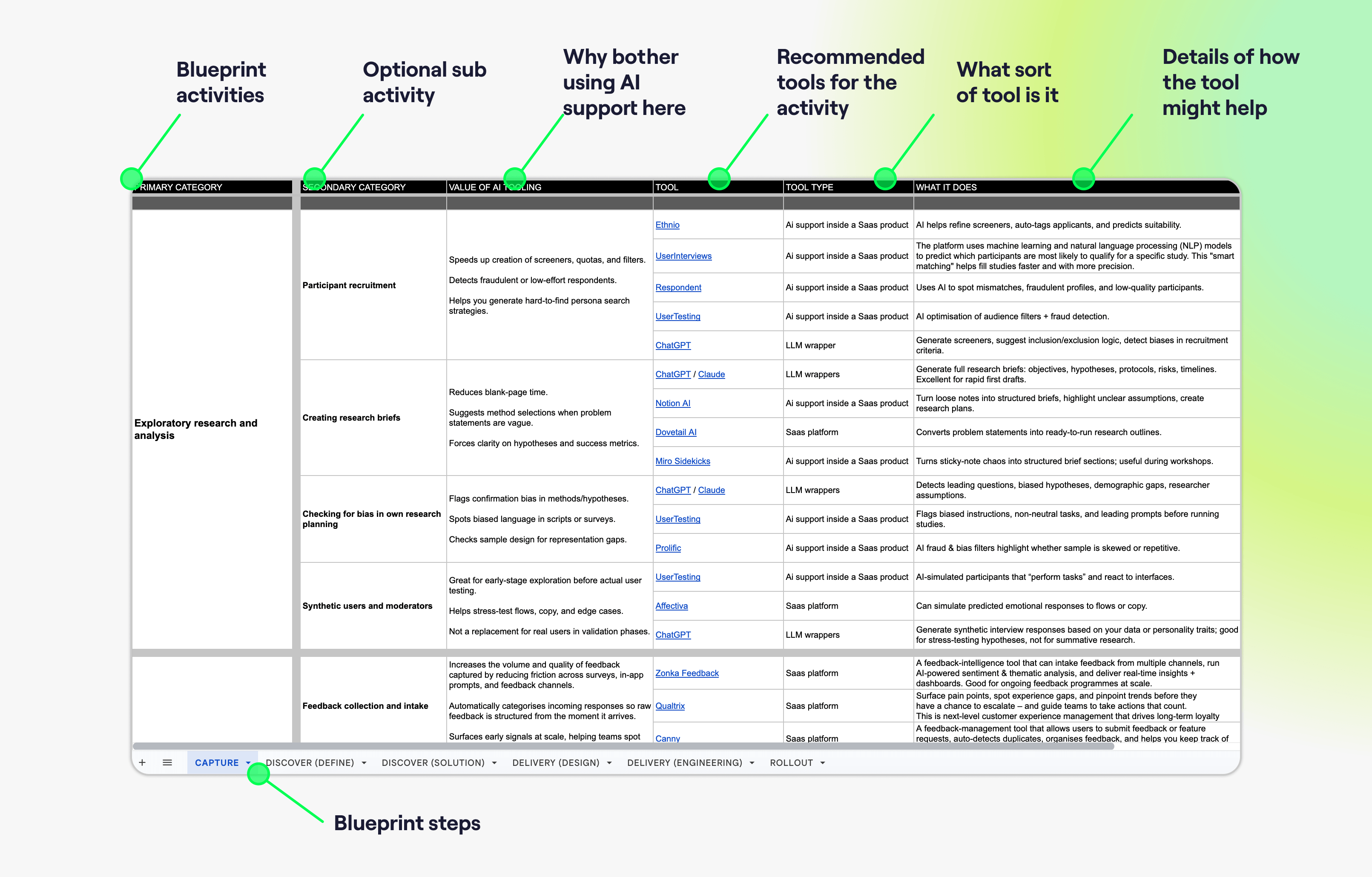
Browse the steps along the bottom. These map directly to the steps along the top of the blueprint and will help you navigate to the part of your workflow you’re most interested in exploring.
Once in a step, you will see:
Column A: The activities that map directly to the blueprint activities that are listed within each step.
Column C: Where a primary activity was very broad, we’ve broken down the activities further to help us be more targeted with recommendations.
Column D: A summary of the value of applying AI practices to that activity / sub-activity.
Column E: Our recommendations for tooling against that activity. This is a mix of tools and processes we’re using, along with deep research we’ve done to fill in any gaps.
Column F: These help categorise the type of tool. They boil down to 4 main categories, A SaaS platform whose main business model is an AI utility, AI functionality embedded within a wider SaaS platform, a prompt wrapper for an LLM, or a plugin.
And within those categories, the recommendations tend to distil down to two use cases. Either an AI agent trained to help with a broad range of tasks, or a proactive utility hyper-focused on doing a single job well.
Column G: A useful description of the specifics of how that tool could help in your day-to-day.
What now?
These recommendations are designed to complement your day-to-day work, not overwhelm it. The goal isn’t volume, but value. That value comes from consciously weighing the benefits against the risks, whether that’s diluting human judgement, hallucinations, security concerns or long-term debt, and deciding where an adapted workflow can lift you out of the weeds and elevate the outcomes you deliver across the product development process.
In reality, we’ve only scratched the surface with this directory. New AI tools and workflows are emerging every month, all focused on removing the mundane, bringing teams closer together, and helping us get more value from the time we have. We hope you find something here worth testing with your teams, mapped clearly to the benefits outlined earlier in the article. And we also hope this prompts you to share some of your AI workflow wins with us and with the wider community!